


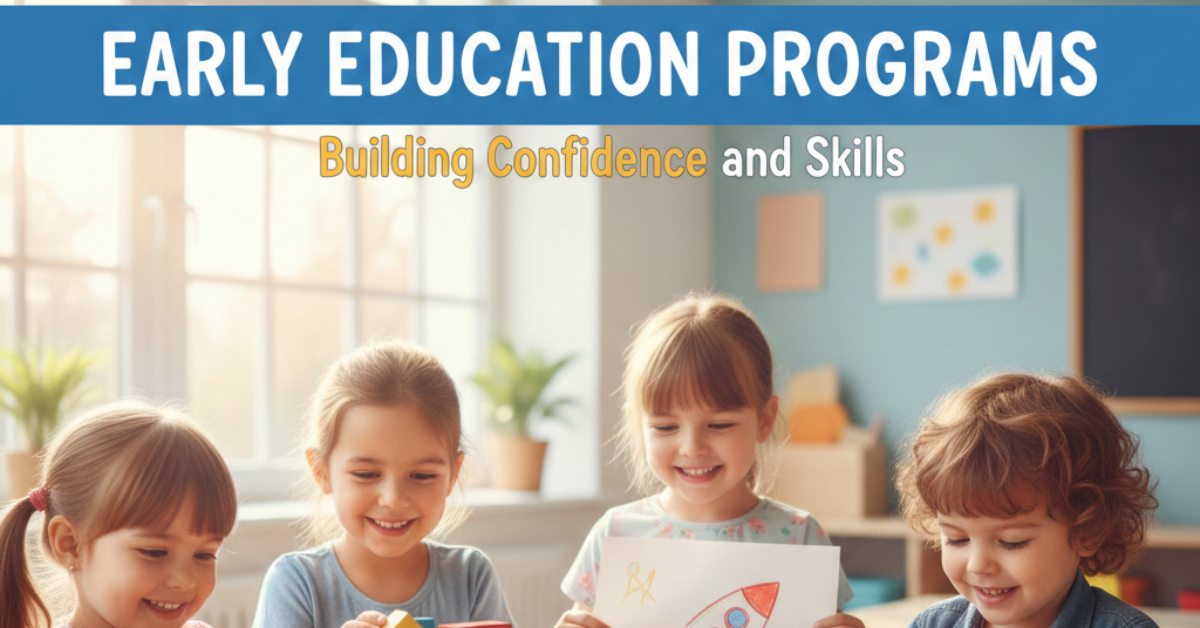
The first few years of a child’s life are often described as magical, and for good reason. It is a time of rapid discovery, where every day brings a new texture to touch, a new sound to mimic, and a new concept to grasp. During this critical window, a child’s brain develops faster than at any other time in their life. While the home environment is the primary source of love and security, high-quality early education programs play an indispensable role in expanding a child’s horizon.
Many parents mistakenly view these programs as simple supervision—a safe place for children to stay while parents work. However, the best early education environments are far more than just childcare. They are dynamic learning labs where the foundations of self-esteem, social intelligence, and cognitive flexibility are laid. By stepping into a structured yet nurturing environment, children begin to build the confidence and skills that will serve them well beyond their kindergarten years.
The Architecture of Self-Esteem
Confidence isn’t something children are simply born with; it is built, brick by brick, through experiences. Early education provides a unique stage for these experiences to unfold. At home, a child might rely heavily on parents to complete tasks. In a classroom setting, however, independence is gently encouraged.
Simple acts—hanging up a backpack, choosing a center to play in, or opening a lunchbox—might seem trivial to an adult. To a three-year-old, these are monumental victories. Each small success releases a wave of dopamine, reinforcing the belief: “I can do this.”
Furthermore, early education programs offer a safe space to fail. When a block tower topples over or a drawing doesn’t turn out as planned, educators are there to guide the child through the frustration. They teach that setbacks are not the end of the road but a natural part of the learning process. This resilience is the bedrock of true confidence. It transforms a child who says “I can’t” into one who asks, “How can I try differently?”
Mastering the Art of Social Connection
One of the most profound benefits of early education is socialization. For many children, this is their first opportunity to interact regularly with a group of peers who are at the same developmental stage. It is a distinct shift from the adult-child dynamic, where the adult often accommodates the child’s needs immediately.
In a classroom, children learn the complex dance of negotiation. They learn that the blue crayon isn’t always available, that they must wait for their turn on the slide, and that other children have feelings, too. These lessons in empathy and cooperation are crucial.
Structured group activities teach children how to listen, how to follow directions, and how to express their own ideas respectfully. These “soft skills” are actually quite hard to master, and learning them early gives children a significant advantage. A child who can navigate a disagreement over a toy today is learning the conflict resolution skills they will use in boardrooms and relationships decades from now.
Cognitive Flexibility and Language
While social and emotional growth is paramount, the cognitive benefits of early education are equally impressive. Young brains are incredibly plastic, meaning they are primed to absorb information and patterns. High-quality programs expose children to literacy, numeracy, and scientific concepts through play, making learning feel like a natural extension of curiosity rather than a chore.
This period is also the ideal window for language acquisition. The exposure to rich vocabulary, storytelling, and diverse forms of communication strengthens neural pathways. This is particularly true for parents who choose specialized programs to boost cognitive development. For example, sending a child to a Spanish immersion school in San Antonio does more than just teach them a second language. It challenges the brain to switch between linguistic codes, which enhances problem-solving skills, improves memory, and boosts overall mental flexibility.
Even in monolingual programs, the exposure to new words and concepts expands a child’s worldview. They learn to ask questions, predict outcomes, and draw connections between disparate ideas. This intellectual confidence ensures that when they eventually enter a formal grade school classroom, they aren’t intimidated by new material—they are excited by it.
The Comfort of Routine and Independence
Uncertainty can be a major source of anxiety for children. Early education programs operate on consistent schedules, providing a rhythm to the day that helps children feel secure. Knowing what comes next—circle time followed by snack, then outdoor play—gives children a sense of control over their environment.
Within this routine, there is freedom. Children are often given choices, allowing them to exercise agency. Do they want to paint or read? Do they want the red cup or the blue one? These micro-decisions build a sense of autonomy. They learn to understand their own preferences and make decisions, a skill that is vital for self-confidence.
Moreover, the separation from parents, while initially difficult, is a healthy developmental milestone. It teaches children that they can be safe and happy in other environments and that their loved ones will always return. This secure attachment, coupled with independent exploration, fosters a robust sense of self.
Preparing for the Future
The goal of early education is not to rush childhood, but to deepen it. It is about providing a fertile ground where curiosity is watered and confidence is allowed to take root. When children feel capable, understood, and socially connected, they approach the world with open arms.
Whether through a traditional preschool, a Montessori program, or a Spanish immersion school in San Antonio, the objective remains the same: to empower the child. By investing in these early years, we aren’t just teaching children how to be good students; we are teaching them how to be confident, capable, and compassionate people. The skills they build in the sandbox today become the tools they use to build their dreams tomorrow.
Read More: Keep What’s Yours: Easy, Real-Life Ways to Protect Your Business From Theft