









Managing teams in multiple locales is no longer the exception; it’s the norm. Companies have offices across continents, employees collaborate from their homes or coworking spaces, and projects move at an alarming pace! So, the question is, what’s the issue? Well, it’s not about staying in touch, it’s getting seamless communication to be clear, timely, and actionable across the globe, regardless of time zone or culture. When systems aren’t in place, it is common for collaboration across countries, departments or offices to ultimately lead to an endless amount of scheduling problems, isolated updates, and competing priorities. Even though modern project management tools are designed for an exact purpose (to address this issue), these technologies embed communication into the workflow derivatives of each day; in other words, communication doesn’t just travel from location to location, it creates consistency as a result.
Lark Messenger: creating shared communication hubs
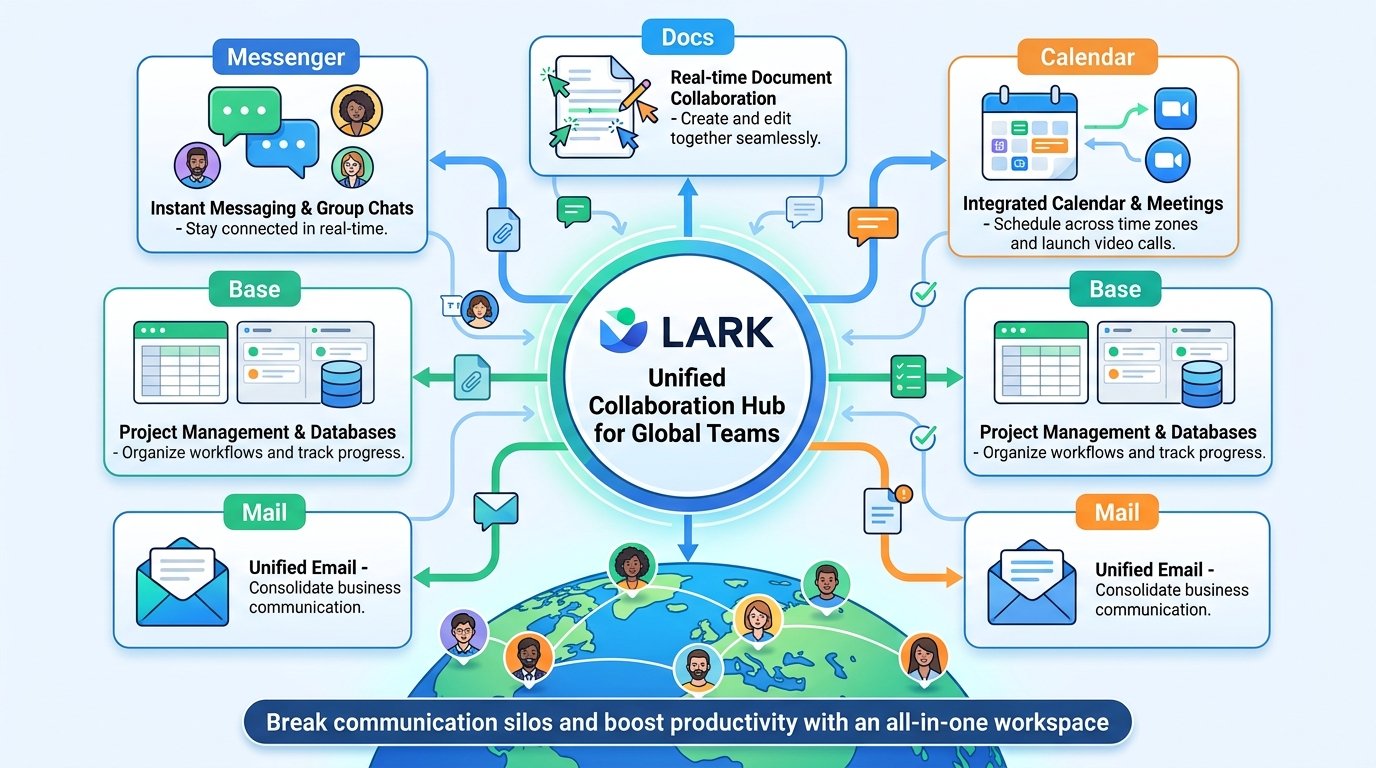
When teams are spread across locations, chat becomes the most immediate communication tool. But without structure, conversations can fragment into isolated channels that no one has the time to track. Lark Messenger ensures clarity by organizing discussions into threads tied to specific projects or departments. This makes it easier for distributed employees to find the conversations most relevant to their work. Pinned updates prevent important announcements from vanishing in busy channels, while Buzz notifications surface urgent matters instantly. Because Messenger connects to tasks and documents, conversations aren’t just exchanges, they become part of the execution chain, ensuring that distance doesn’t dilute accountability.
Lark Calendar: aligning time zones without friction
One of the greatest barriers to multi-location teamwork is time. Scheduling across time zones often leads to late-night calls, early-morning meetings, or missed connections. Lark Calendar addresses this by automatically accounting for global time differences and showing availability across regions. Shared views make it easier to see when entire departments are available, while reminders ensure participants come prepared with the right context. By embedding clarity into scheduling, Calendar turns the challenge of time zones into a smoother process where everyone, regardless of location, has an equal chance to contribute effectively.
Lark Base: keeping responsibilities transparent across sites
As teams spread out across offices, it is common for visibility into responsibilities to become foggy. Lark Base solves this by providing structured, customizable databases where anyone from the team who is located anywhere can see tasks, milestones and deliverables. Dashboards create accountability for leaders to see what progress is being made without constantly asking, while departments that have their own departments can customize views based on their own workflows. Automations keep the records current, so everyone can see real time progress without needing to do manual updates. By connecting customer pipelines with internal workflows, Lark goes beyond being just a database and is similar to how a CRM app streamlines information: monitors, tracks, and moves forward the whole sales event in one place. This ensures communication extends beyond internal updates to include external deliverables, making accountability clear and consistent across every location.
Lark Docs: breaking barriers to content collaboration
Working on documents in different locations can be an absolute hassle when you have to go back and forth via email or local storage. Lark Docs gets rid of that friction and enables real-time co-editing on a single shared document. Employees from different locations can work on the same strategy, proposal, or report simultaneously, seeing edits happen as they happen. Inline comments connect discussions to particular sections of a document, retaining the context and providing actionable feedback. The version history allows for flushing out the evolution of ideas and how decisions were made. Docs make content collaboration borderless, giving distributed teams the same clarity and speed as if they had been in the same room to brainstorm.
Lark Minutes: ensuring global alignment on meeting outcomes
Meetings are already complex across a single location—spread them across multiple time zones, and they become even more challenging. Lark Minutes helps by capturing transcripts, generating AI summaries and surfacing action items automatically. Employees who were not able to attend a live session can review highlights at their convenience, ensuring they remain aligned with their colleagues. Action items connect directly to tasks, which keep follow-through visible. Searchable archives mean conversations from past meetings can be revisited without duplicating discussions. In multi-location contexts, Minutes ensures that critical knowledge is never lost and that all team members, regardless of attendance, have equal access to outcomes.
Lark Approval: structuring decisions across geographies
Approvals often stall when requests cross multiple regions, with time differences slowing down response times. Lark Approval resolves this by standardizing how requests are submitted and routed. Structured forms capture all necessary details, reducing clarification delays, while automated routing ensures requests reach the right person instantly. Notifications in Messenger show pending approvals where employees already collaborate, making it harder for requests to go unnoticed. Each approval is logged, ensuring transparency about who made which decision and when. By embedding decision-making into an automated workflow, Approval ensures that distance doesn’t slow projects down. Instead, it reflects that sign-offs happen in predictable, accountable ways.
Lark Mail: connecting external communication with internal teams
With global operations, we tend to have more external communications with clients, vendors, and regulators in multiple geographies. The use of Lark Mail means these exchanges won’t become siloed in an employee’s personal inbox and will become connected to broader workflows. Shared mailboxes allow cross-location teams to handle client communications collaboratively and ensure that no individual accepts the entire share of follow-up. Emails can be connected to Docs, Base, or Tasks, further assuring updates and commitments are tracked in a single system. Employees can catch up from different time zones with filters and search, and check-in with appropriate permission for sensitive messages. No matter where work happens, Mail keeps external and internal messaging in alignment.
Lark Sheets: data collaboration without silos
Distributed teams need data a lot, but when spreadsheets are all over the place, it’s tough to keep everyone on the same page. Lark Sheets lets teams in different spots work together in real-time. People can update, see, and check out the same info at once. Permissions show who owns what, and special formatting points out any red flags right away. Since Sheets can pop up in Docs or dashboards, the data stays part of what you’re doing instead of being stuck in one file. Notifications tell folks when things change, so everyone knows what’s up – turning data work into something clear and ongoing, no matter where people are.
Conclusion: building communication systems for distance learning
Teams spread out in different places have problems, like keeping everyone on the same page when they can’t always talk in real-time. Digital tools can fix this by keeping chats, updates, and who’s doing what out in the open. Lark does just that.
With Messenger, chats are structured. Calendar deals with time differences. Base makes sure everyone’s accountable, no matter where they are. Docs lets people work together on stuff around the world. Minutes keep track of what was said in meetings. Approval makes decisions easier. Mail ties together emails from inside and outside the company. And Sheets lets everyone share data live.
With these tools, working with teams in different locations isn’t a pain. It becomes simple and well-organized. Instead of dealing with miscommunication or things taking too long, workers can be sure that communication is clear and things get done. In today’s world, good communication between different locations is not just about being fast. It’s about building a system where clarity and accountability move just as fast as your messages.